The El Fabar Ordovician Tunnel
Uncovering a Fossil Treasure Trove in Spain
by Nando Musmarra
English Translation by Wendell Ricketts
Paleoart by Loana Riboli
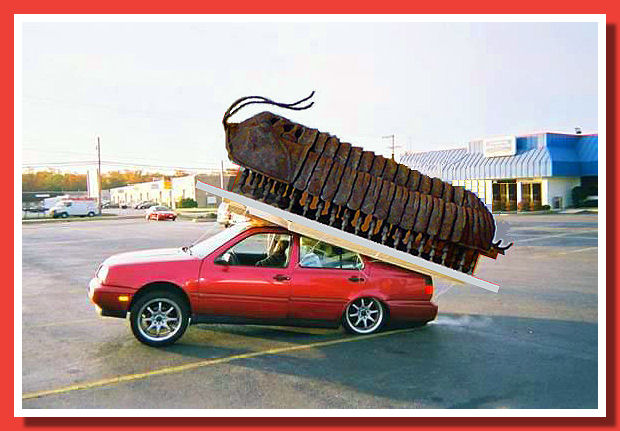
Giant model of Neseuretus tristani built byi Maquetas Lezzagon. Image digitally modified by Nando Musmarra.
The Asturias, 2002. The mechanic pushes down with all his might on the back bumper of paleontologist Juan Carlos Gutiérrez-Marco’s automobile, then jumps on the front fender for good measure, causing the entire car to bounce. The paleontologist watches, a quizzical, worried look on his face. At last, the mechanic shakes his head and says, “I told you, Professor ... you can’t overload your car like that. The springs are shot. The only solution at this point is to completely replace the shock absorbers....”
Gutierrez-Marco glances at the substantial estimate that the mechanic hands him and responds with a resigned nod. “Okay, okay,” he says. “Anyway, it was worth it ... if I had to do it all over again, I’d still fill the car to overflowing with all those fantastic fossils!”
And it’s true. The marvelous Middle Ordovician fossils discovered during excavations for the El Fabar Tunnel near Ribadesella, Spain, were definitely worth it—worth driving back and forth over the nearly 500 kilometers that separate the coast of the Asturias from Madrid’s Museo Geominero (Natural History Museum), and worth facing the crossing, over and over again, of the precipitous slopes of the Cantabrian Mountains.
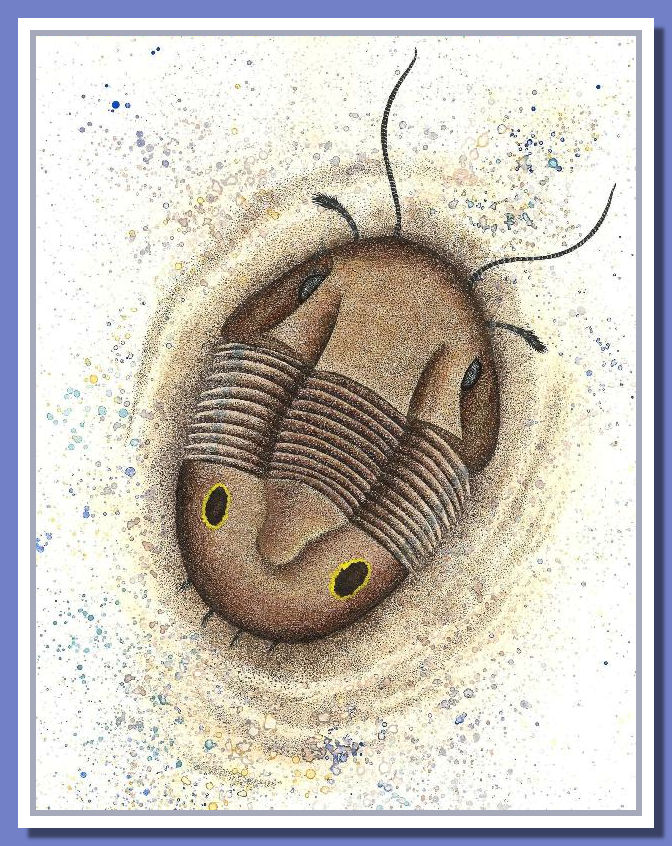
Ectillaenus giganteus (Burmeister, 1843) - Paleoart Loana Riboli © 2009
Some 400 million years ago, the Cantabrian Mountains, along with the Asturias and much of the Iberian Peninsula, constituted the coastal and marine-platform environments of an area to the north of the super-continent known as Gondwana. Located at the latitude occupied by today’s South Pole, Gondwana united in a single landmass what would become South America, Africa, India, Antarctica, and Australia. Some 140 million years later, Gondwana was on a collision course with the minor supercontinent Laurasia, made up of the North American protocontinent and Baltica, Siberia, the Kazakhstan Block, and significant parts of northeastern China. The tremendous lateral forces caused by the collision between Gondwana and Laurasia gave birth to major mountain ranges (the so-called Variscan or Hercynian orogeny) that included the Appalachian Mountains in North America and the Urals and the Cantabrian Mountains in Europe.
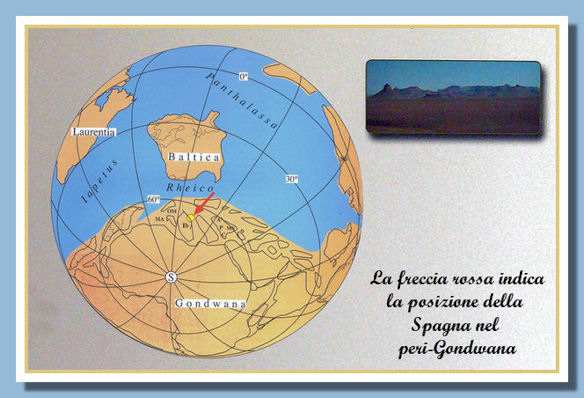
Geographical position of Spain in the Peri-Gondwana terrane. Diagram courtesy of the Museo del Territorio de Ribadesella.
In the process, Paleozoic sediments in Spain, which had been gently accumulating, one layer at a time, for more than 225 million years, were rotated 90º into a nearly vertical position. The result was the Cantabrian Mountain range, which follows a horizontal line that runs parallel to the coast of the Cantabrian Sea and extends for nearly 500 kilometers.
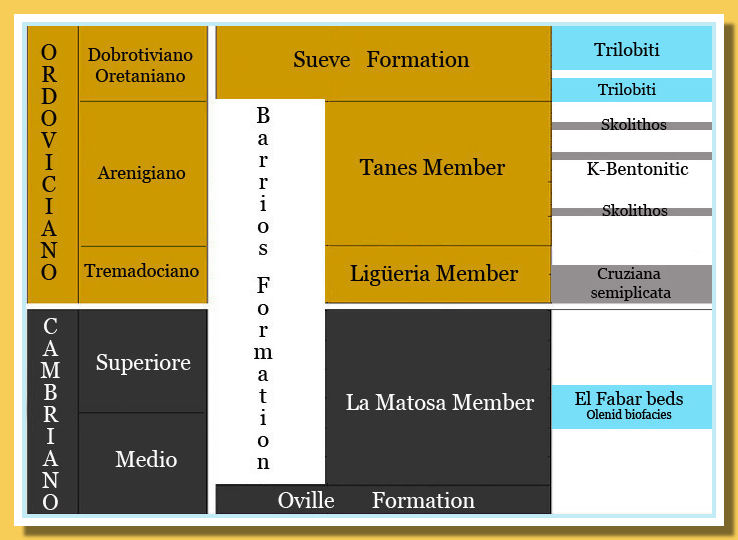
Diagram showing stratigraphic position of the Sueve Formation. Created by Nando Musmarra from a diagram in the Museo del Territorio de Ribadesella.
You won’t find a long tradition of paleontological study of the Asturian Ordovician reflected in the scientific literature—either because the exposures are incomplete and discontinuous or because they were significantly deformed by the gargantuan forces generated during the meeting of the continental masses that formed the Cantabrian Mountains. In fact, the first mention of the Ordovician of the Asturias takes us back in time to 1916 and to the posthumous publication of an intriguing description by mining engineer Luis de Adaro y Magro of “Silurian” trilobites and brachiopods from the iron mines of Caravia (the work was completed by his student, Gumersindo Jonquera). Today, those mines are completely depleted and have been sealed.
In 1942, another mining engineer, Primitivo Hernández Sampelayo, reanalyzed de Adaro y Magro’s specimens, pushing their age back into the Ordovician. In 1967, the geologist Jesus Pello, with a study of Middle Ordovician graptolites from the Cantabrian Mountains, rekindled interest among his colleagues at the University of Oviedo by proposing a geological correlation between the Sierra del Fito and the Sierra del Sueve/Río Nalon Valley.
At that point, however, research on the Ordovician fossil record in the Asturias came to a halt, and remained moribund for twenty years. As late as the mid-1980s, scientists accepted as a given the existence of a stratigraphic gap (which, in some cases, extended for eighty million years) in the Ordovician, maintaining that younger Silurian or Devonian sediments directly overlie the late Cambrian and early Ordovician quartzites of the Barrios Formation. (This excludes, of course, the Ordovician exposures of the Laviana Nappe exposed along the shoreline near Aviles.)
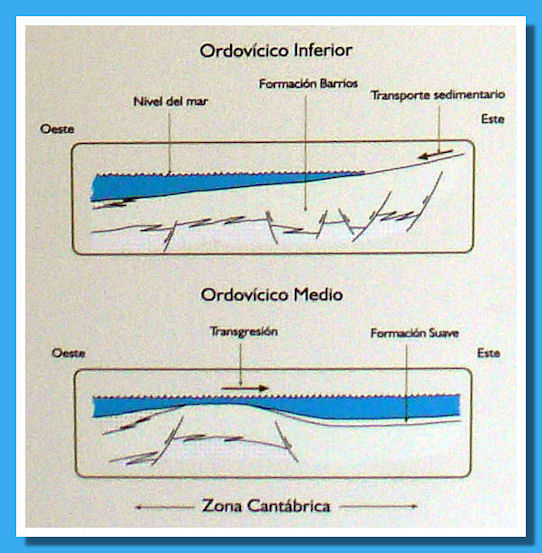
The beginning of the Ordovician is marked by the scarcely fossiliferous quartzites of the Barrios Formation. During Middle Ordovician marine transgressions, meanwhile, the dark, fossiliferous clays of the Sueve Formation were deposited. Diagram courtesy of the Museo del Territorio de Ribadesella
What had become of eighty million years of Ordovician sediments? Perhaps the Asturias were above water during those eons, and no marine sediments were deposited. Alternately, sediments may have been laid down, but later entirely eroded away. Or, perhaps more likely, a combination of these factors may have been the decisive element. In an attempt to close the “Ordovician gap,” a multidisciplinary team composed of specialists from various universities in Spain, France, and Italy (e.g. the University of Pisa) was given the task of carrying out new stratigraphic studies. The group included Juan Carlos Gutiérrez-Marco from Madrid’s Museo Geominero—at this point, he still didn’t know the project would eventually cost him a new set of shock absorbers!—and José Carlos Garcia-Ramos, professor of stratigraphy at the University of Oviedo and today director of MUJA (the Jurassic Museum of the Asturias).
The team’s investigations, conducted under the aegis of the International Commission on Stratigraphy, focused on the reexamination of Ordovician stratigraphic data from some ten type localities and on the formalization of the description of the Middle Ordovician Sueve Formation. The study lasted more than ten years, and its results (among the most important of which was the identification of approximately fifty species of macrofossil, some reported from Spain for the first time), were widely discussed at conferences on the Ordovician held in Las Vegas, Nevada, in 1995 and in Prague in 1999. The difficulties paleontologists encountered in studying and characterizing the discontinuous and highly deformed Sueve Formation exposures— which, as the reader will recall, represent both coastal and marine-platform sediments deposited to the north of Gondwana—nonetheless left many questions unresolved.
Just as the Spanish scientific community was wondering how it might learn more about the Ordovician of the Asturias, a discovery was made whose impact on paleontology would be astounding. In 1998, during the construction of the A8 Freeway, which runs parallel to the Cantabrian Mountains along the northern coast of the Iberian Peninsula, hillside drilling near the coastal town of Ribadesella (northeast of Oviedo) provoked a sudden landslide and exposed a remarkable section of the Sueve Formation.
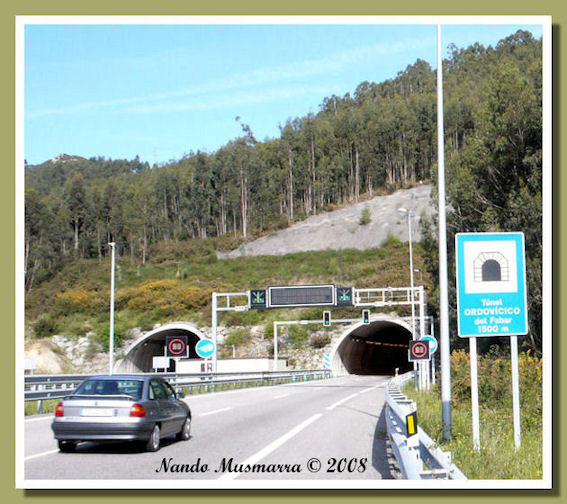
The eastern approach to the El Fabar Ordovician Tunnel. Photo: Nando Musmarra.
Once the landslide area was cleared of debris, what came to light (a figure of speech, given that we're talking about a tunnel more than 1,380 meters or just under a mile in length) was a highly fossiliferous sequence of dark argillaceous sediments oriented in a nearly vertical position. The opening of this window into the Sueve temporarily halted excavations, and paleontologists wasted no time in verifying that the exposure was a sequence of the Middle Ordovician Sueve Formation, preserved in its entirety at the El Fabar Tunnel site. For scientists, it was a once-in-a-lifetime opportunity: the excavations passed horizontally through the nearly-unknown Sueve Formation, offering them the chance to read the book of Ordovician time as if they were leafing through it, page by page.
Construction of the El Fabar Tunnel (in reality, two separate, parallel galleries, each of them about ten meters wide and six meters high and connected by emergency corridors) was widely covered by the media, and newspaper reporters quickly dubbed the site the “El Fabar Ordovician Tunnel”—emphasizing the paleontological treasure trove over the construction project itself.
El Fabar was a project of firsts: the first time construction firms allowed outsiders to participate in such a dangerous project and the first time in Spain that a tunnel was excavated using a novel technique known as NATM—The New Austrian Tunneling Method.
NATM was substantially different from techniques that had previously been used for tunnel construction in Spain. In traditional excavations, for example, work progressed via the use of explosives; as the opening grew, the tunnel was consolidated with reinforced concrete support vaults that were built into place. The NATM approach, in contrast, was based upon rock’s inherent ability to support itself. NATM was certainly less dangerous; above all, however, it was less invasive and destructive. NATM involved small, repeated advancements, generally on the order of meters each day (it has been described as a “design as you monitor” approach). Large drilling or mining machines carried out the main excavations, and subsequent work phases were planned according to the rock and other conditions that were then observed on-site.
Each day, excavations advanced in two cycles, each of which was subdivided into a sequence of steps:
1) Giant drilling and mining machines were used to create and expand the tunnel opening, and the rock was then allowed to “breathe” and settle for a few minutes between drilling sessions.
2) The upper level of debris was cleared to create a space big enough to allow special low-profile cement mixers
to enter the newly excavated gallery.
3) The walls and ceiling vaults were reinforced using pressure-sprayed concrete or “shotcrete.”
4) Rubble was cleared away.
5) The walls and ceilings were further strengthened with arc-welded linings, rock bolts, wire centring, and steel ribs.
6) A final, thicker layer of shotcrete was applied.
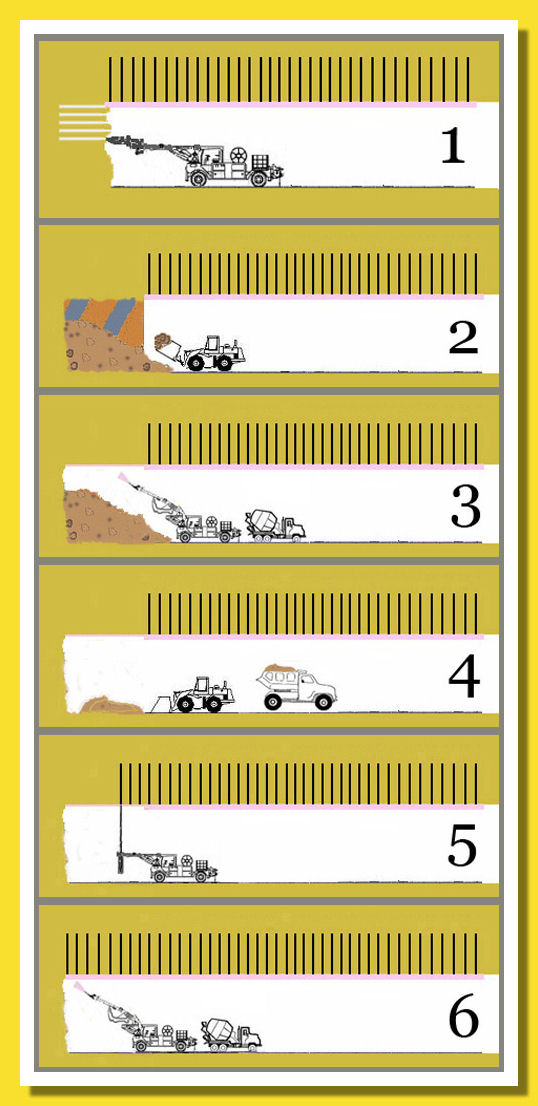
Various phases of excavation during construction of the El Fabar Tunnel. Image modified from an illustration published in Gutiérrez-Marco & Bernárdez (2003).
On the one hand, the use of NATM techniques kept costs under control and allowed work on the tunnel to progress more quickly. On the other, it forced paleontologists into a race against time. Sample collection had to take place and stratigraphic surveys had to be completed in the few minutes available between Phase 2 and Phase 3 (that is, before shotcrete was applied to reinforce the walls).
Excavation of the two galleries of the El Fabar tunnel was carried out simultaneously by four teams, two working from each side of the hill. The plan was for them to meet up, years later, in the middle.
Concerned about losing important stratigraphic data, and given the impossibility of following the work of all four teams at once, paleontologists decided to focus their meticulous recovery efforts exclusively on the south-gallery team, which had begun working from the western side of the excavation.
When the progress of tunneling work allowed it, scientists hurried to take stratigraphic measurements of the walls. During the phases in which shotcrete was being applied to one side of the gallery, paleontologists— wearing only safety helmets, working in semi-darkness, and surrounded by deafening noise— rushed to the opposite wall to collect as many specimens as possible.
As the tunnels advanced (growing by some six to ten meters a day), the major difficulty that paleontologists faced was synchronizing their efforts with the cycles of excavation work and organizing their team members to take best advantage of the thirty-minute, twice-daily periods in which stratigraphic measurement and specimen collecting were possible. Because the design of the tunnels took them at a slight angle to the Sueve exposures, excavations in the north gallery were a few days behind those in the south gallery. On those occasions when scientists experienced an unanticipated snag in their sampling and collecting efforts, then, they could sometimes still recover their work by shifting to the adjacent tunnel; alternately, if a particularly interesting layer were uncovered, paleontologists could exploit a second chance to study and sample it simply by changing galleries.
Once they had finished with their work inside the gallery, scientists followed the trucks that dumped excavation debris outside the tunnel. They carefully noted the precise stratigraphic provenance of the excavated rock so they could later return and collect from those piles at leisure.
Piles of shale were also sometimes left outside to dry in the sun (once dry, the slabs tended to open by themselves along a natural plane; if split when “fresh,” on the other hand, they fractured conchoidally, which often ruined the fossils inside). On one particular day, however, the piles disappeared. Perhaps a worker had taken them away to be dumped, perhaps an overzealous surveyor had used them to level a work site, or perhaps they had been employed as filler for some highway project and covered with asphalt ... the only certainty was that a genuine treasure had been lost. Paleontologists were able to recover some of the missing information by taking samples through a window opened especially for them in the shotcrete in a gallery service corridor. This disturbing experience led the scientists to modify their methods, however, and from that moment on they took personal responsibility for transporting the most interesting material to a building that the construction firm made available to them. In a very short time it was literally filled with specimens, and soon after so was the garage, and then the garden....
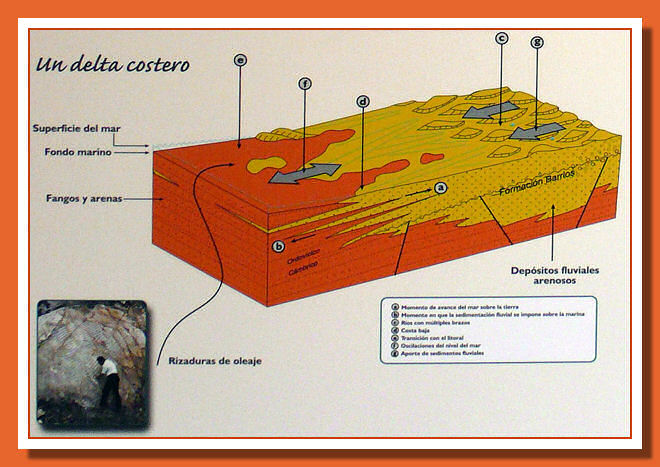
Depositional phases straddling the Cambrian and Ordovician periods. Diagram courtesy of the Museo del Territorio de Ribadesella.
Financing for the El Fabar research was limited and, once the on-site space had been exhausted, scientists began to use their own vehicles to carry material from the tunnel on the long journey to the Museo Geominero in Madrid, some 500 kilometers away, loading their cars with an average of 300 kilograms of rock each trip. They even asked their friends and relatives for help, taking advantage of their vacation trips between the beaches of the northern coast and the Spanish capital. Quite a few of them rose to the occasion: in a short time, an entire floor and then the attic of the Museo Geominero were filled to overflowing with fossil material. Working a little at a time, the museum staff removed specimens from the matrix, reducing them to dimensions more suitable for further geopaleontological study in the laboratory.
The Museo Geominero’s work on the El Fabar site was considered of extreme importance throughout the international scientific community because the resulting data described one of the most complete Cambrian/Ordovician successions in Europe. That information, in turn, was essential for establishing the exact position of western Europe in the Peri-Gondwana period.
At the end of the El Fabar studies, funds allocated by the Ministry of Transportation allowed the fossils to be put on permanent display at the Museo del Territorio de Ribadesella, located in the village of El Carmen a few kilometers from Ribadesella, where they were to spend the rest of their already long lives. An outpouring of national media attention, however, which in turn generated enormous popular demand, quickly turned the exhibit into a travelling show. As a result, Spaniards from all across the country were given the chance to admire the fossils from the famous Ordovician tunnel excavation.
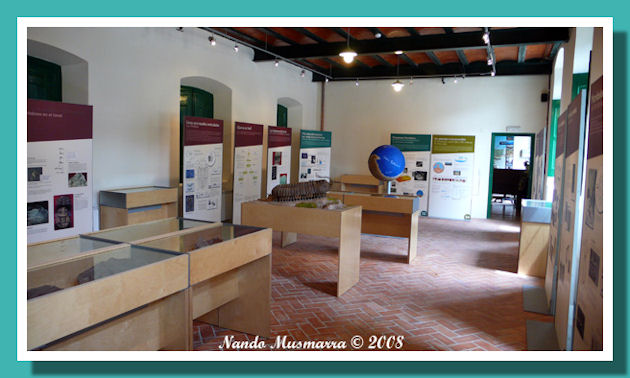
One of the exhibit halls in the Museo del Territorio de Ribadesella. Photo: Nando Musmarra.
In 2005, El Fabar Fever took hold of me as well. I arrived at the Museo del Territorio de Ribadesella only to discover, to my disappointment, that the fossils were “out of town” on one of their frequent trips. I decided to make do with a visit to the upper floor of the museum (reluctantly, at first), where I learned all there was to know about the “Indianos”—that is, the Asturians who emigrated to the New World and, especially, to the West Indies and Cuba, during the 1800s. Those who were successful overseas often returned to the Asturias and built luxurious houses, planted at least a single palm tree in their gardens and, above all, dedicated body and soul to the elimination of illiteracy in the Asturias. In a Europe whose residents barely knew how to read or write, it’s impressive to consider that Asturians could boast of 100% literacy by the 1900s.
I returned to the Museo del Territorio de Ribadesella in 2008. This time, at last, the El Fabar fossils had all returned to home base and were there to welcome me—as was the museum’s Director, Teresa del Campo, who served as my guide through the phenomenal world of the Asturian Paleozoic.
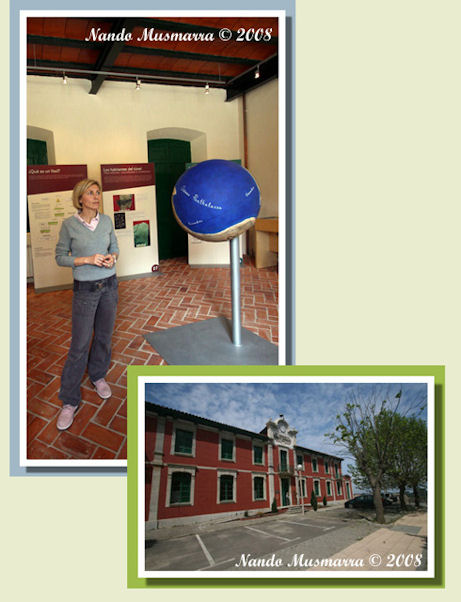
The Museo del Territorio de Ribadesella. Photos: Nando Musmarra.
Layer by layer, and beginning with the deposits of the Barrios Formation, Teresa showed me the fossils discovered at El Fabar. The Barrios Formation’s approximately 800 meters span a period from the most recent section of the Middle Cambrian to the beginning of the Middle Ordovician. This formation, largely composed of coastal marine sediments, has yielded trace fossils of deep-ocean, bottom-dwelling organisms, including olenid trilobites and graptolites. The Barrio Formation’s oldest member, the La Matosa Member (which includes the El Fabar beds and their abundant phyllocarids and palynomorphs), directly overlies the glauconitic sandstones of the Oville Formation (Middle Cambrian). It was here that the oldest trilobite from the El Fabar Tunnel, Parabolina sp., was found.
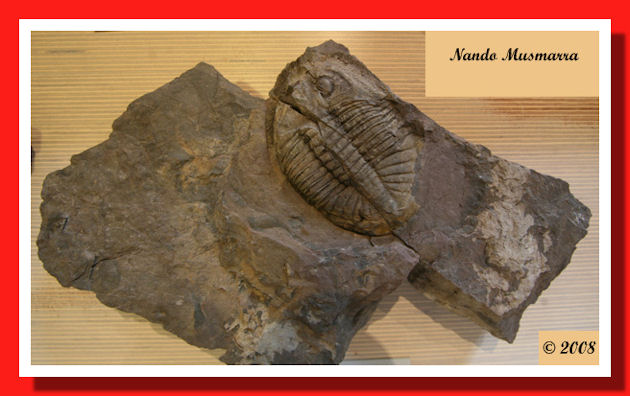
Isabelinia glabrata (Salter 1853). Photo: Nando Musmarra.
The Ligüeria Member, located at the center of the Barrios Formation, contains the final evidence of the ichnofossil Cruziana semiplicata with which the Tremadocian, the oldest period of the Ordovician, comes to an end. The most recent section of the Barrios Formation (the Tanes Member) contains numerous ichnofossil (Skolithos) horizons, which proved useful for regional stratigraphic correlations; fossil traces produced by both predators and detritus feeders (rusophyciform “bathtub burrows”); and the classic continuous trails produced by seafloor dwellers common during that epoch. The Tanes Member also contains lingulid shell beds and the remains of trilobites, bivalves, and conodonts (Protopanderodus, Drepanodus, Drepanoistodus), along with ostracodes and such problematic taxa as Hanadirella. Graptolites, including the so-called “Chinese graptolite” Azygograptus undulatus are abundant (the discovery of Azygograptus fossils for the first time outside of present-day Asia suggests the presence of Peri-Gondwanan currents that facilitated the organism’s migration) and Eremochitina brevis (Eremochitina, identified for the first time in Spain, links these exposures to the Cambrian Middle Arenigian).
An additional and extremely significant find was the unexpected discovery of a K-bentonite bed (correlated with the Pedroso Bed of the central Asturias). As a result, scientists were able to establish that the volcanic ashfall from a Cambrian mega-eruption had extended all the way to the western Asturias. Data from the El Fabar excavations showed that this eruption was the most powerful ever to have occurred in Spain, with a magnitude ten times greater than the 1991 eruption of Mount Pinatubo in the Philippines.
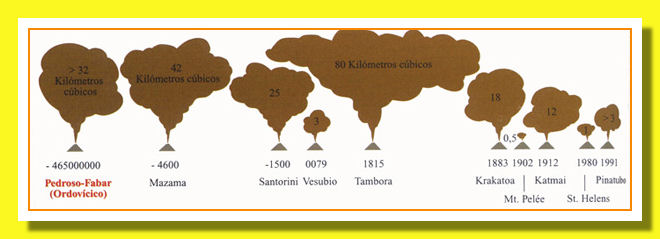
Comparison of ashfall, in square kilometers, from history’s most massive volcanic eruptions. Diagram courtesy of the Museo del Territorio de Ribadesella.
The El Fabar exposures also provided scientists with the first evidence of Ordovician oil in Spain, an occurrence reported from beds at the transition point between the Barrios (Cambrian/Ordovician) and the Sueve (Ordovician) Formations.
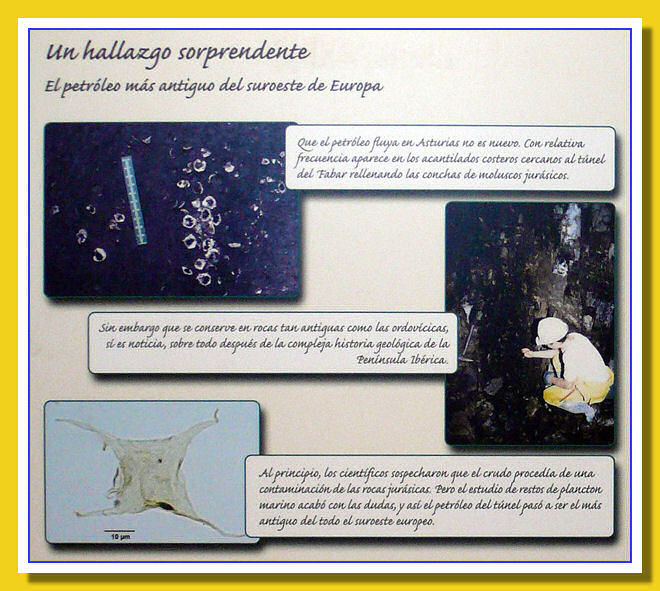
Scientists initially believed that oil deposits were the result of intrusions of Jurassic rock. Studies of fossil plankton, however, confirmed that the Paleozoic oil of El Fabar is the oldest in all of southeastern Europe. Illustration courtesy of the Museo del Territorio de Ribadesella.
Teresa guided me to the display cases that contained the fossils for which the El Fabar Tunnel is famous. The stratigraphic succession from which these Ordovician fossils come—which includes six major depositional sequences and fifty-four parasequences—is illustrated on a wall diagram nearby. Even at a scale of 1:100, the diagram is more than six meters long! Many invertebrate species, some of them unknown and others reported for the first time in the Spanish and European fossil record, were identified in the Sueve Formation, the youngest of the Ordovician sediments exposed at El Fabar.
As I wandered through the Museo del Territorio de Ribadesella, what immediately caught my eye was the fact that trilobites are the best-represented group among the El Fabar fossils, both in terms of diversity and in terms of sheer numbers. Ordovician trilobites from four orders (Phacopida, Corynexochida, Lichida, and Asaphida) are on display, as are excellent specimens of Parabolina sp., representing a fifth order, the Ptychopariida, found in the Cambrian strata of the El Fabar Bed.
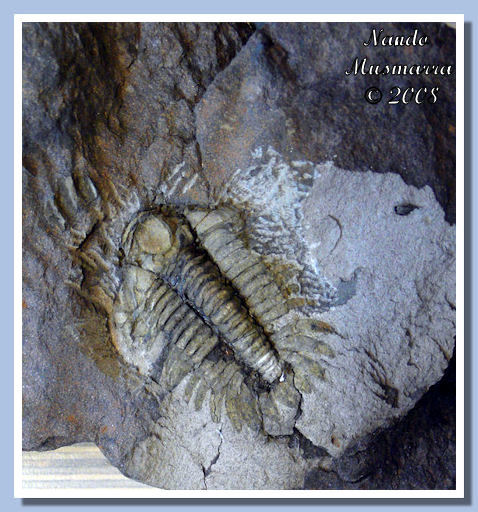
Eccoptochile almadenensis (Romano 1980). Photo: Nando Musmarra.
In the Order Phacopida, the El Fabar Tunnel site yielded four species of trilobites from the Superfamily Calymenoidea (characterized by a fusiform or spindle-shaped glabella): Neseuretus tristani (Brongniart in Desmarest 1822), Colpocoryphe rouaulti Henry 1970, Salterocoryphe salteri (Rouault 1851), and Prionocheilus mendax (Vanëk 1965). Representatives of the Superfamily Dalmanitoidea are also common El Fabar specimens, including Phacopidina micheli (Tromelin 1877), Crozonaspis morenensis (Hammann 1972), and Morgatia cf. primitiva Hammann 1972. Of particular interest was the exceptional find of a specimen of Zeliszkella toledana (Hammann 1971), the rarest dalmanatid trilobite found in the El Fabar Tunnel. The discovery of representatives of the Superfamily Cheiruroidea, including a Placoparia (Coplacoparia) tournemini (Rouault 1847) mortality plate, provides evidence that these trilobites lived in social groupings. Eccoptochile almadenensis Romano 1980 completes the list of phacopids recovered from the El Fabar Tunnel.
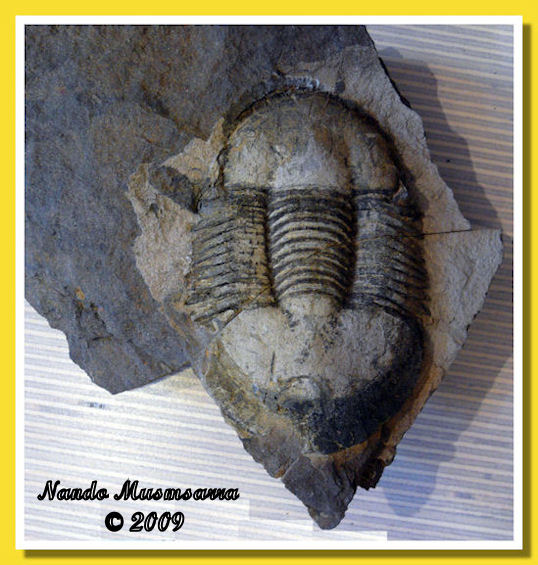
Ectillaenus giganteus (Burmeister 1843). Photo: Nando Musmarra.
The Order Corynexochida is represented by Ectillaenus giganteus (Burmeister 1843), easily identified because of a pygidium that tends to be the same shape and size as the cephalon. Ectillaenus is perhaps the most aesthetically pleasing of all the El Fabar trilobites.
Species belonging to the Order Lichida are also well represented by Selenopeltis macrophtalma (Kloucek 1916) and Selenopeltis aff. kamila Snajdr 1984. Finally, a partial specimen of the giant trilobite, Uralichas cf. hispanicus Verneuil & Barrande 1856 (Superfamily Lichoidea), had paleontologists crossing their fingers until the very end of excavations, hoping for an exceptional find (unfortunately, it was not to be).
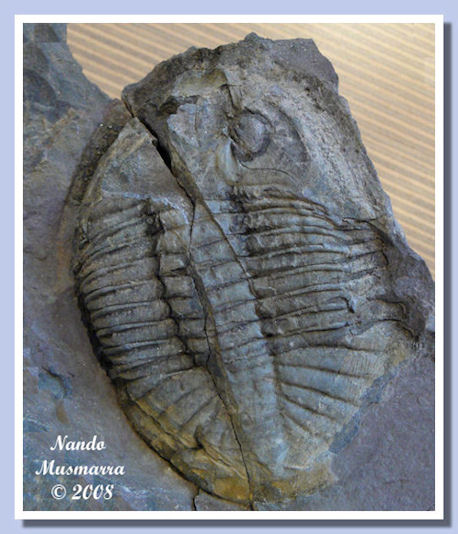
Close-up of Isabelinia glabrata (Salter 1853). Photo: Nando Musmarra
The asaphids from the El Fabar Tunnel, including Nobiliasaphus nobilis (Barrande 1846) and Isabelinia glabrata (Salter 1853), are notable for their medium to large size. In addition, the presence of open-sea species such as Parabbarrandia cf. crassa (Barrande 1872), Dionide mereki Henry & Romano 1978, and members of the Family Raphiophoridae, indicate that the Peri-Gondwanan ocean reached considerable depths at some points.
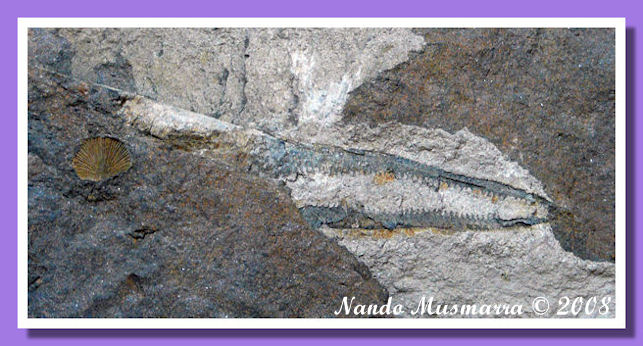
Graptolite
One cannot fail to note that other invertebrates are less abundant and less diverse in the Ordovician exposures at El Fabar (with respect to trilobites) than they are in similar European strata of the same age. My attention was particularly drawn to the fairly diverse assemblages of ostracodes (including new species and the oldest known paleocopes and binodicopes), conodonts (Drepanoistodus suberectus, Panderodus, and Semiacontiodus), possible ichthyoliths (if their identification is confirmed, they would be the oldest evidence of vertebrates in Europe), and other, less common fossils such as machaeridians and conularids. The presence of graptolites and chitinozoans was also significant, permitting the Sueve Formation to be assigned definitively to the Middle Ordovician.
I was especially intrigued by the so-called “problematic taxa”—that is, organisms that are still awaiting a definitive description and taxonomic classification. These included the enigmatic machaeridians (“armored” worms) and hyoliths. We know where and when they lived but almost everything else about these animals, including the role they played in an ecosystem dominated by those Lords of the Paleozoic, the trilobites, has yet to be discovered.
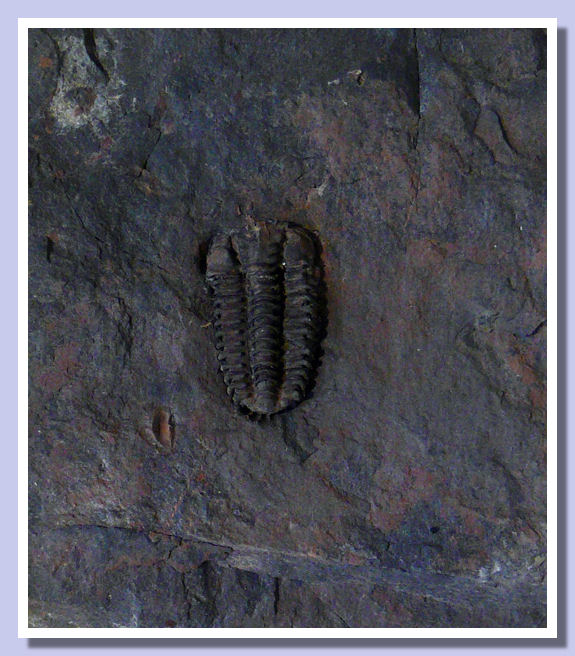
Placoparia (Coplacoparia) tournemini (Rouault 1847). Photo: Nando Musmarra.
My visit to the Museo del Territorio de Ribadesella at an end, I returned to my car to get ready for the trip back home. It was only at that moment that I realized, speaking of massively overloaded automobiles, that mine was nothing to sneeze at. The rear wheels showed the strain of the serious cargo I had packed onboard—not trilobites, but more than 250 kilograms of extremely heavy cubic pyrite I’d found in a lucky expedition to a quarry in the Province of La Rioja. I knew I’d need to be extra careful on the drive back to Italy. Once I was home, in fact, I’d probably need to stop by my auto mechanic’s and ask him to take a look at my shock absorbers!
Works Consulted:
Guidi Cestelli, C. (1987). Geotecnica e Tecnica delle Fondazioni, Vol. 1. Milan: Hoepli.
Gutiérrez-Marco, J. C. & Bernárdez, E. (2003). Un Tesoro Geologico en la Autovia del Cantabrico. Madrid: Ministerio de Fomento.
Gutiérrez-Marco, J. C., Bernárdez, E., Rábano, I., Sarmiento, G. N., Sendino, M. C., Albani, R. & Bagnoli, G. (2003). Ordovician on the Move: Geology and Paleontology of the “Túnel Ordovícico del Fabar” (Cantabrian Free Highway A-8, N Spain). Serie Correlación Geológica No. 17: 71-77. San Miguel de Tucumán (Argentina): Instituto Superior de Correlación Geológica (INSUGEO). Available from http://dgisrv15.unt.edu.ar/fcsnat/insugeo/geologia_17/10.htm.
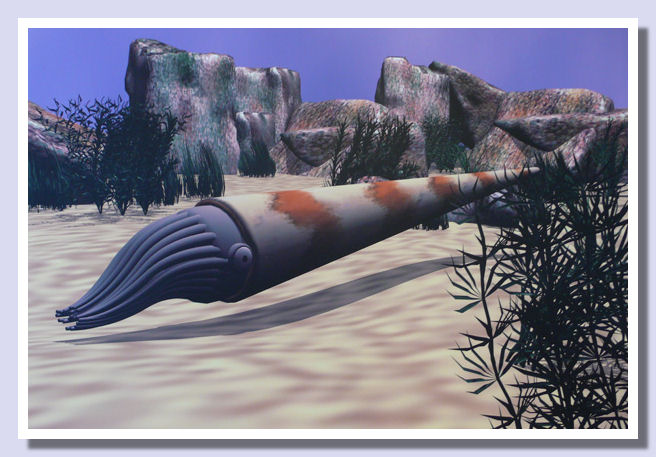
Image courtesy of the Museo del Territorio de Ribadesella.
Many thanks to Teresa del Campo of the Museo del Territorio de Ribadesella in El Carmen for her help.
Nando Musmarra & Wendell Ricketts © 2010
This article was published on Fossil News Vol. 16 - N.07 - July-Agoust 2010